Black Central América(s): Ebbs and Flows of Hemispheric Blackness
Editors: Kaysha Corinealdi, Natasha Gordon-Chipembere, Paul Joseph López Oro, and Nicole D. Ramsey
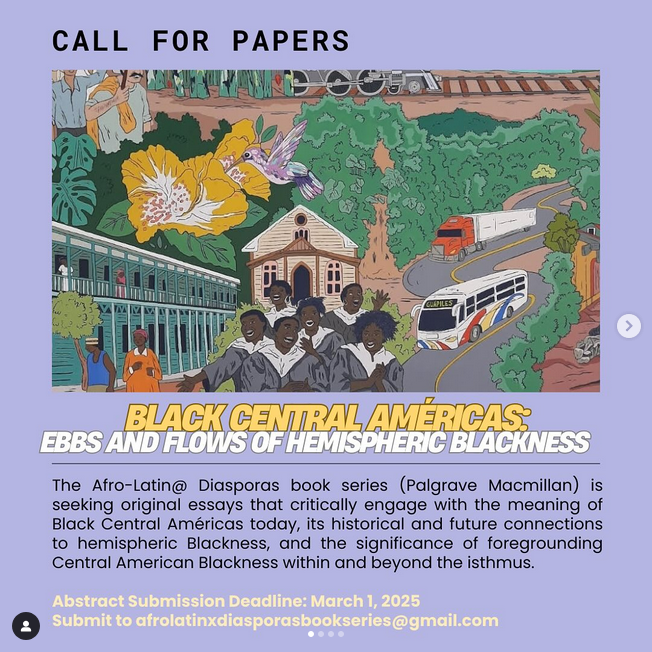
Image of mural at Universidad de Costa Rica, Limón Campus. (Image courtesy of Natasha Gordon-Chipembere, poster design by Nicole D. Ramsey).
Call for Papers
In recent decades, the fields of Black Studies, African Diaspora History, Afro-Latin American Studies, and Afro-Latinx Studies have seen an explosion of research on transnational and hemispheric Black Latin American communities. Yet, Black Central American knowledge production remains understudied and undertheorized notwithstanding a rich genealogy of scholarship that includes Armando Fortune’s early writings on the first Africans in Panama and Myrna Manzanares’ campaign to preserve the Kriol language in Belize. Black Central América(s): Ebbs and Flows of Hemispheric Blackness expands on the foundational work of these early scholars while tapping into a robust and growing field of Black Central American Studies invested in understanding socio-political and cultural links that stretch throughout the isthmus and to various diasporic communities.
As a collective of Black Central American scholars, we propose to curate histories of Black knowledge production on the isthmus that predate nineteenth-century independence movements and take us into twenty-first-century discussions of equality, justice, citizenship, and belonging. This edited volume will map out genealogies of Black Central American life in all of its modalities and regional specificities, with particular attention given to gendered discourses of inclusion and exclusion, how Black communities have created robust archival and memory keeping models, generational shifts and convergences regarding LGBTQ+ visibility and activism, the place of imperial, multinational, and neocapitalist practices and policies that both depend on and exclude Black life, and the role of artists and cultural practitioners in imagining different forms of isthmian and hemispheric belongings. In our articulations, we also remain attuned to the nation-state as a geopolitical border of mestizo nationalism and colonial legacies grounded in ideologies of anti-Black and anti-Indigenous racism, while recognizing that Black Central Americans have long-battled to be included into and/or create alternative ways of citizenship and national belonging.
For this collection, the editors invite scholars from a wide array of disciplinary and transdisciplinary approaches, creative non-fiction writers, journalists, community organizers, and advocates to contribute original work that reflects on the meaning of Black Central Américas today, including past and future links to hemispheric Blackness, and what it means to foreground Central American Blackness within and beyond the isthmus.
Contributors are invited to, but not limited, to write on the following themes:
- The building of community archives
- The centrality of Black communities in nation-building projects
- The labor of Black Central American women
- LGBTQ+ art, culture, and protest
- Indigenous and Afro-Indigenous living histories
- Black isthmians and environmental justice
- The legacies of cimarronaje/maroonage
- Transnational and diasporic activism
- Intergenerational allegiances and tensions
- Blackness, religion, and spiritual practices
- Negotiating diaspora and language
- Intellectual and political genealogy of Black Central Americans
- Black histories and activism in Belize, El Salvador, and Guatemala
Submit your abstract no later than March 1, 2025, to the Editors at: afrolatinxdiasporasbookseries@gmail.com
Although publications are in English, we will consider abstracts in Spanish (subject to the author securing resources for full manuscript translation into English). The abstract must be 250 words and include your name, title, institutional affiliation (if applicable), and contact information.
 Dr. Kaysha Corinealdi